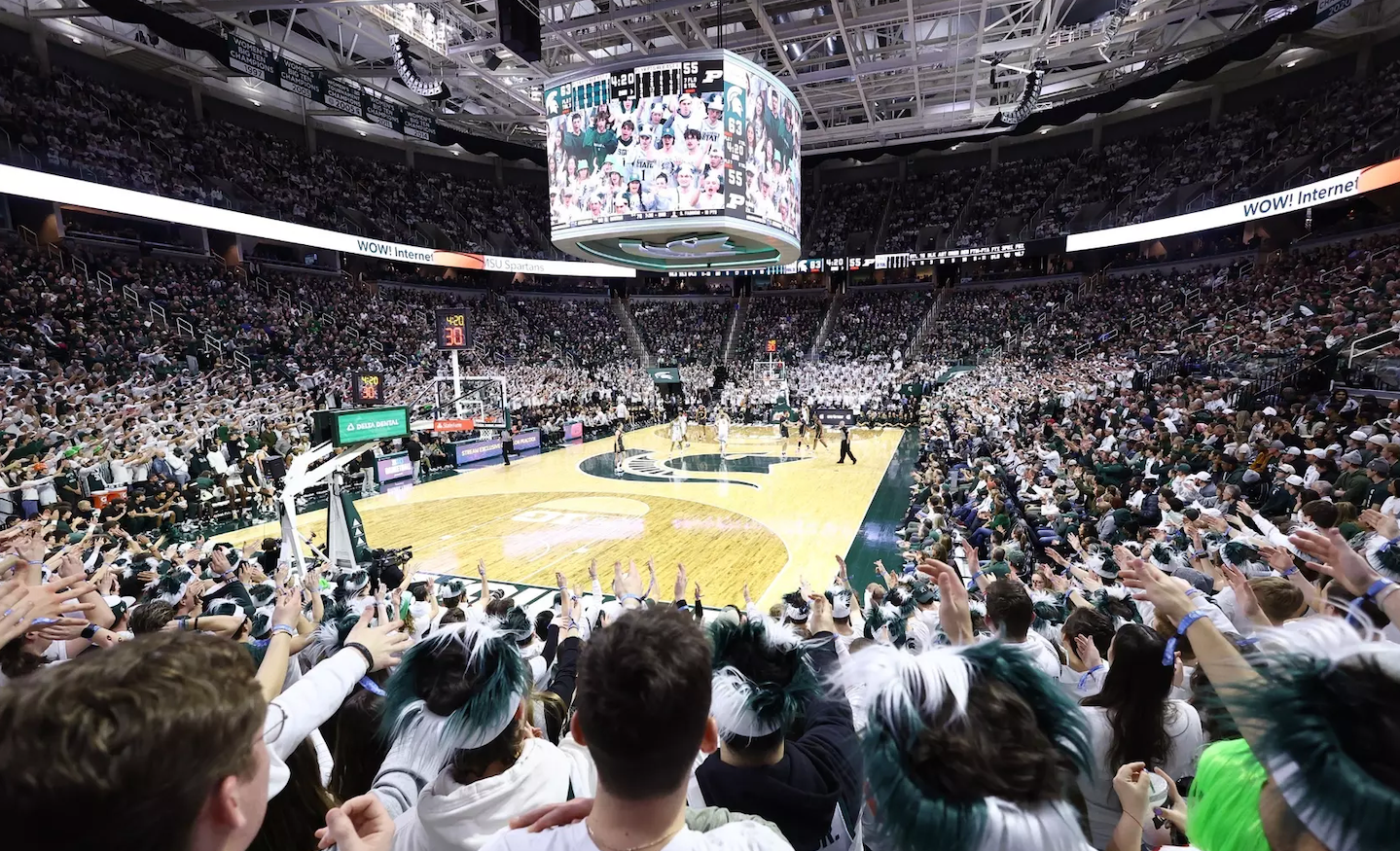
Emily Hayashi is a second-year graduate student pursuing a Ph.D. in kinesiology and an M.A. in clinical mental health counseling. She earned her B.S. and M.S. in kinesiology at California State University, Fullerton, and is now a research and teaching assistant in Michigan State’s Department of Kinesiology, under the guidance of Leapetswe Malete, associate professor and coordinator of global initiatives in the Department of Kinesiology. Hayashi’s current research explores mental health and well-being of NCAA Division I international student-athletes.
For a long time, I thought I was supposed to find my passion somewhere. I searched for it in school, sport, and everything I did, as if I would eventually discover it hiding behind the next team, next season, or next accomplishment. But nothing ever quite clicked in the way I expected.
Sports came the closest. I fell in love with everything about it, but especially the community. There was something about the way sports could bring together people from different backgrounds — around a shared goal, holding them through wins, losses, and everything in between.
As a Japanese American woman and former student athlete, I became aware early on how identity influences belonging, and how easily certain lived experiences can go unseen in sports and beyond. That awareness deepened through my own experiences with sport-related concussions. Because these injuries were often invisible, they made me more attuned to challenges that are not immediately visible to others, particularly mental health struggles.
Coupled with my cultural background, and the broader expectations I grew up with — many admittedly came from my own high standards — I noticed how stigma and culture influence how people respond to those struggles, especially in spaces where toughness is often praised and vulnerability is sometimes viewed as weakness.
Such observations prompted further questions about society’s definitions of “strength” and “perseverance,” concepts that seemed to epitomize masking, staying silent, and pushing through, even when it came at a cost — that cost being individual’s well-being.
These experiences led me to think more intentionally about stories that often go unheard in sports. This is what drew me to research international student athletes (ISAs) who represent only about 5% of the NCAA, yet total more than 25,000 students each year. ISAs embody the intersection of sport, education, culture and adaptation. They leave their home countries to pursue academic and athletic goals abroad, while also navigating new cultural norms, language barriers and feelings of isolation, while simultaneously balancing the pressures that come from collegiate athletics.
In my work, I focus on ISA mental health and help-seeking during cultural transition, including how stigma and institutional culture shape how individuals experience and talk about struggle. Many of the students I work with are highly visible on their playing field yet rarely centered in conversations regarding wellness and support. I aim to amplify their voices as their stories reveal how global mental health, transnational migration, and culture intersect in ways that aren’t always captured in traditional research.
Through this work, I’ve come to realize that my passion is not something I needed to search for, but rather something I can bring into everything I care about. It’s reflected in how I approach culturally responsive research, in my collaborations across institutions, and in my commitment to connecting research to meaningful change.
More than anything, my work reflects who I hope to be: someone who makes research meaningful by making tangible differences in people’s lives.
EVENT
Global Learning Expo
October 8, 2026
NEWS
Photo contest celebrates international engagement
EVENT
A Conversation on Global LGBTQIA+ Experiences
October 7, 2026

NEWS
Celebrating 20 years of Muslim Studies at MSU