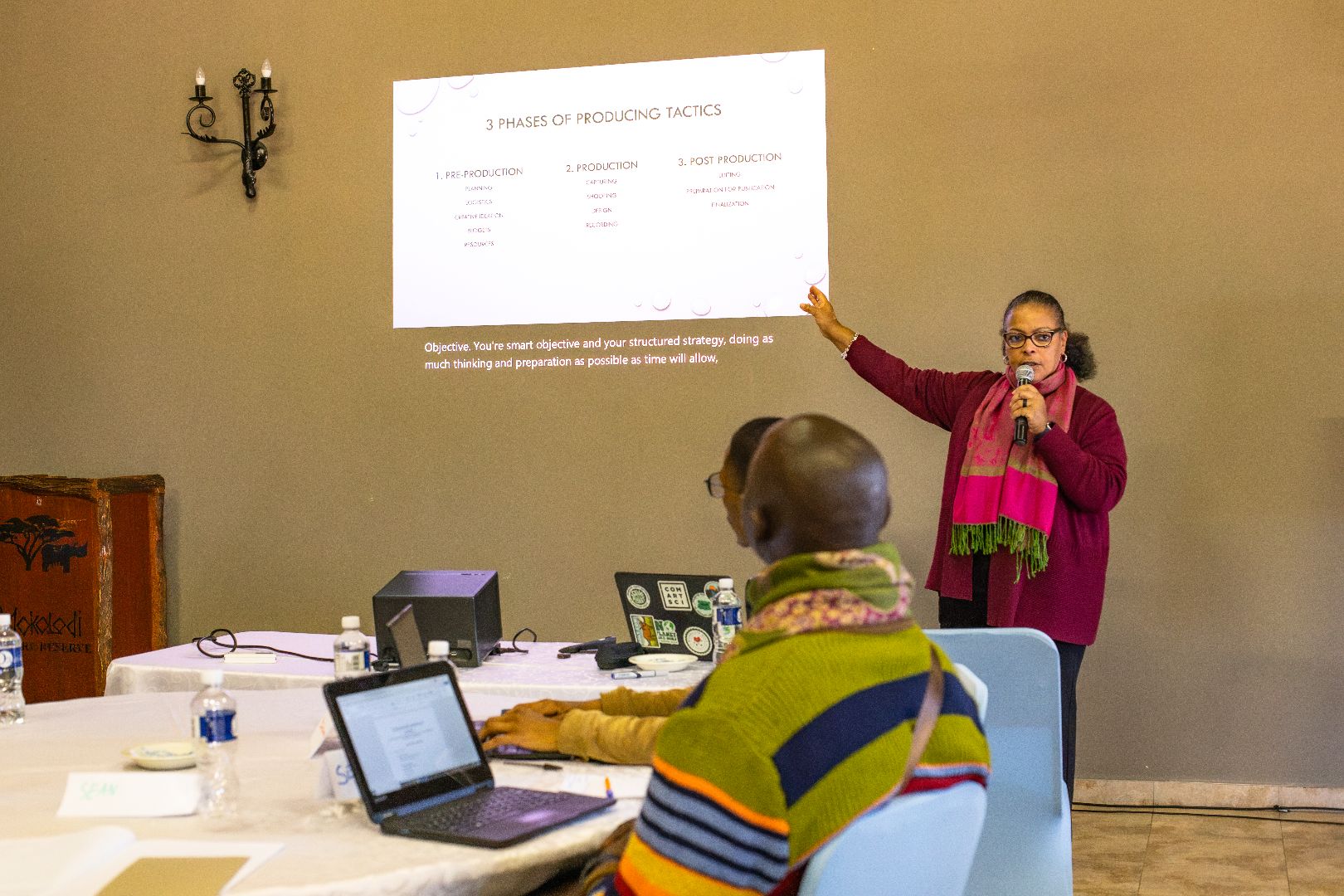
Susan McFarlane-Alvarez is a professor in the Department of Advertising and Public Relations in the College of Communication Arts and Sciences. Her research examines the intersections of identity, images, and corporate expression, exploring how historical, cultural, and ideological forces shape representations in advertising and strategic communication. Her recent work focuses on the interrelatedness of inclusion and sustainability during times of (poly)crisis.
After spending a fulfilling week in Botswana, I left with feelings you might experience after a visit with good friends, even family. My colleagues from the University of Botswana’s chemistry department — Dikabo Mogopodi, Taye Demissie, and Inonge Chibua, have filled an 18-month timeline of my inbox and early Friday morning meetings with mindful collaboration on communication strategies for scientific researchers.
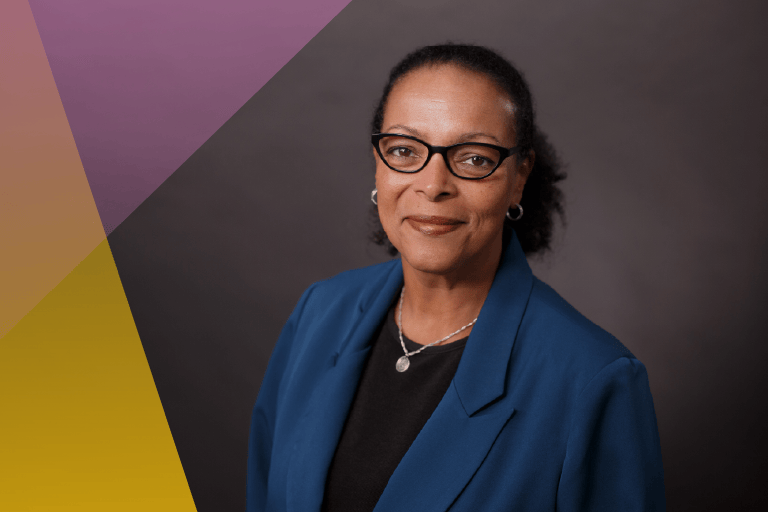
From the moment our team received notification from MSU’s Alliance for African Partnership that our PIRA grant proposal was selected in Dec. 2024, we worked collaboratively to develop a communication program for post-graduates and early career researchers that trains them to communicate their findings and data in ways that are more accessible to the public. Our phased and modular approach included a pre-workshop seminar, introducing participants to the basic principles of strategic communication, and a two-day workshop in Gaborone, Botswana hosted this past July.
Following my visit to Botswana to facilitate the workshop, the University of Botswana team and Tebogo Mostwetla, a graphic and publication specialist, will visit Michigan State to further advance our insights and strategize the project's sustainability into future collaborations.
I arrived in Gaborone, prepared with my learning outcomes for the doctoral and master’s students who would participate in the two-day workshop titled, “Using Strategic Communication to Build Science Research Impact,” wrapped around a tight itinerary. I left having learned how science at the University of Botswana is uncovering knowledge about water resilience, newly created compounds and their real-world applications, and research on wastewater reuse and its sustainability implications.
I also left with a new lexicon that includes “pula” — part blessing, celebration and a wish for rain to bring life to the semi-arid land; and “kgotla” — the convening of community with listening across difference. Botswana, where each member of a community is given a turn to speak, was the ideal backdrop for our conversations about trust and meaningful engagement between researchers and their stakeholder communities.
One of my favorite chapters in this journey was traveling with a busload — or rather a fortitude — of graduate students and audibly delighting with them as we spotted impala and later a herd of five giraffe. Each one of us left the Mokolodi Nature Reserve with true fulfillment for our shared learning, the joy of each other’s encouragement, and our mutual regard for building towards a science-informed, communication-fortified future, where trust builds through discursive interactions among scientists and their diverse communities and stakeholders.
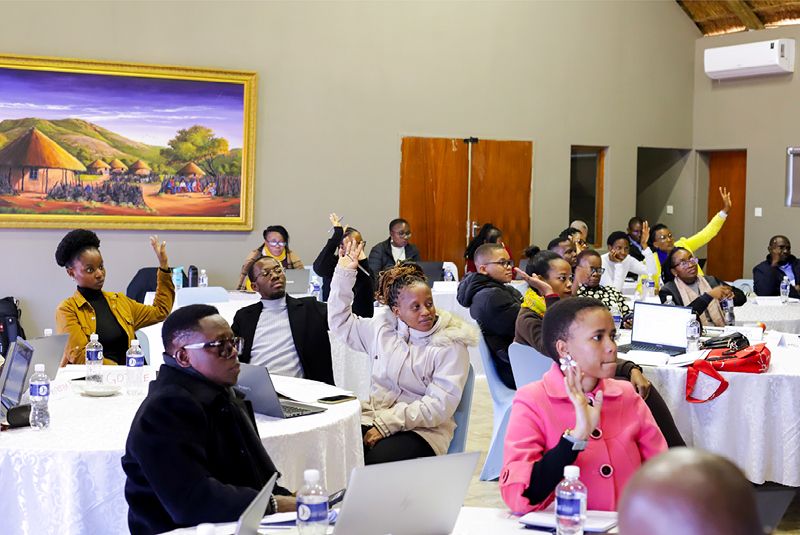
Over the two days, discussions resonated most meaningfully as participants realized that sharing their expertise more widely could change lives and change communities. Through the workshop modules of creative and collaborative exercises, students came to fully appreciate that a more intentional and planned approach to communicating scientific research means defining audiences and carefully constructing messages that are designed to achieve specific objectives.
As we close Phase 2 of this program, I’m grateful to Michigan State University’s Alliance for African Partnership whose Partnerships for Innovative Research in Africa (PIRA) grant funds this collaborative work. I’m also grateful to my colleague John Besley, who shared his science communication expertise and whose writing informed key modules of the workshop.
The College of Communication Arts and Sciences welcomes the University of Botswana team to campus from August 25-30, when they will meet with faculty and students in ComArtSci, at MSU’s Department of Chemistry and at the Facility for Rare Isotope Beams (FRIB).
Workshop photos courtesy of the University of Botswana.
EVENT
Muslim Journeys Campus Walking Tour
October 15, 2026
NEWS
Photo contest celebrates international engagement
EVENT
Returned Peace Corps Volunteers Tell Their Stories
October 19, 2026
NEWS
Celebrating 20 years of Muslim Studies at MSU