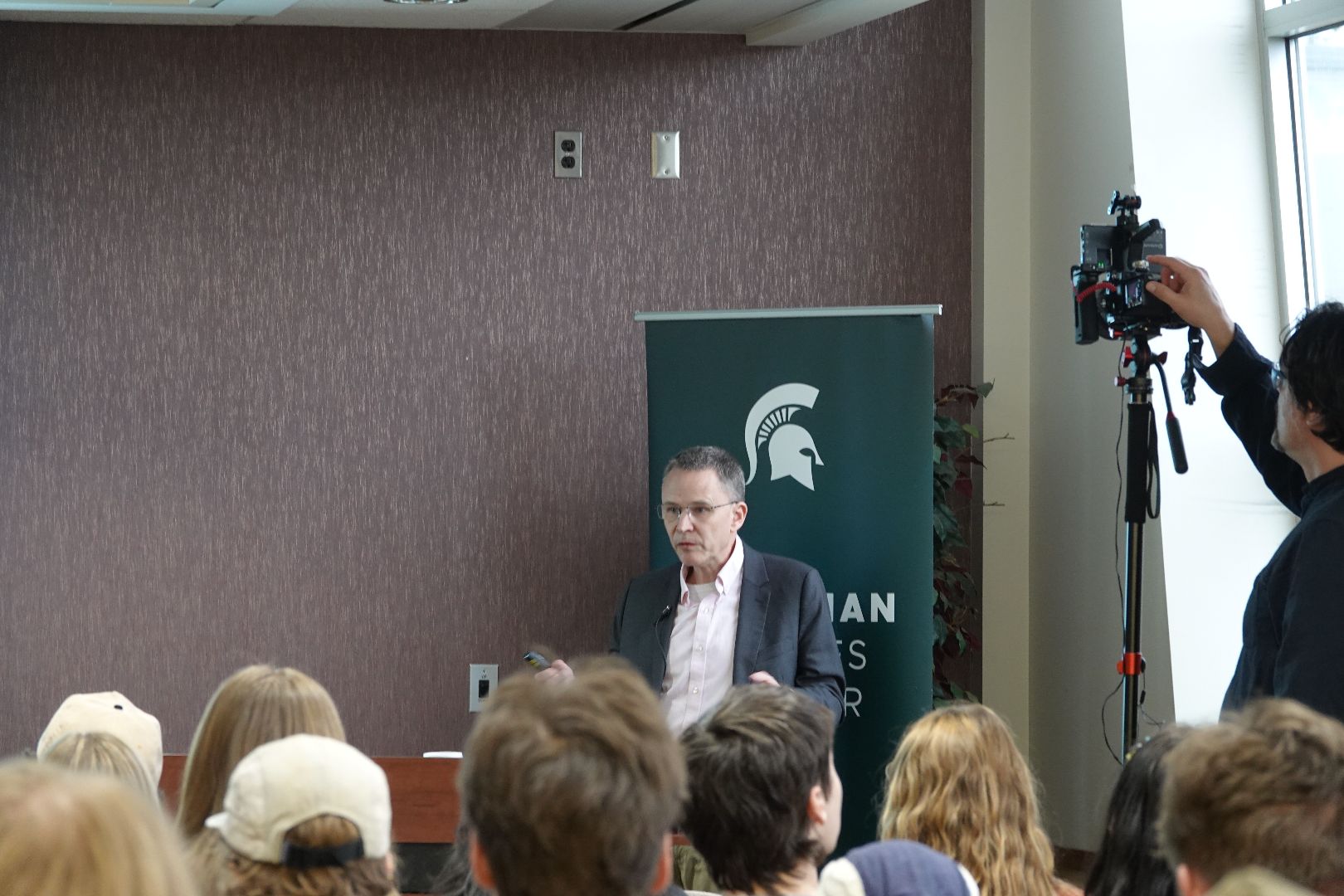
On April 6, 2026, the Canadian Studies Center hosted Peter Johnson, deputy director of the Great Lakes St. Lawrence Governors and Premiers (GSGP), for a day of campus meetings and an afternoon lecture on the Great Lakes Compact and Agreement.
The GSGP is made up of American governors and Canadian premiers in the Great Lakes- St. Lawrence region who work together via the GSGP to address shared issues related to the Great Lakes, the world's largest freshwater system, and a resource and ecosystem critical to Michigan and neighboring communities on both sides of the border.
Johnson's campus visit builds on the center's productive engagement with the GSGP, including our attendance at the GSGP's 2025 Quebec City leadership summit.
“The Canadian Studies Center is pleased to continue our meaningful engagement with Great Lakes issues,” said Rebecca Malouin, director of the MSU Canadian Studies Center. “The Great Lakes are critical to Michigan and our Canadian neighbors, and addressing pressing issues, from water use to environmental stewardship, requires concerted efforts by communities on both sides of the border. We are proud that MSU is a leader in this space.”
During his visit, Johnson spoke with students in FW 449: Wildlife Policy about the GSGP's Great Lakes initiatives, and met with a wide range of faculty from the MSU Institute for Water Research, Michigan Sea Grant, Departments of Community Sustainability and Fisheries and Wildlife, to discuss areas of possible collaboration between MSU and GSGP.
Johnson also delivered a lecture on the Great Lakes Compact and Agreement. Ratified by all Great Lakes-region states and provinces, the Compact and Agreement set legally binding standards related to the removal of large quantities of water from the Great Lakes-St. Lawrence basin. Johnson discussed the legal, policy, and community dynamics of drafting and ratifying such a complex agreement, as well as how it is enforced in practice.
The lecture, co-hosted by the MSU Water Alliance and Department of Fisheries and Wildlife, was attended by over 70 students and faculty representing several colleges and was followed by a robust Q&A.
EVENT
Joseph & Lucy Lee Memorial Lecture
November 4, 2026

NEWS
Photo contest celebrates international engagement
EVENT
Universal Human Rights Through Indigenous Lenses
November 10, 2026

NEWS
Celebrating 20 years of Muslim Studies at MSU