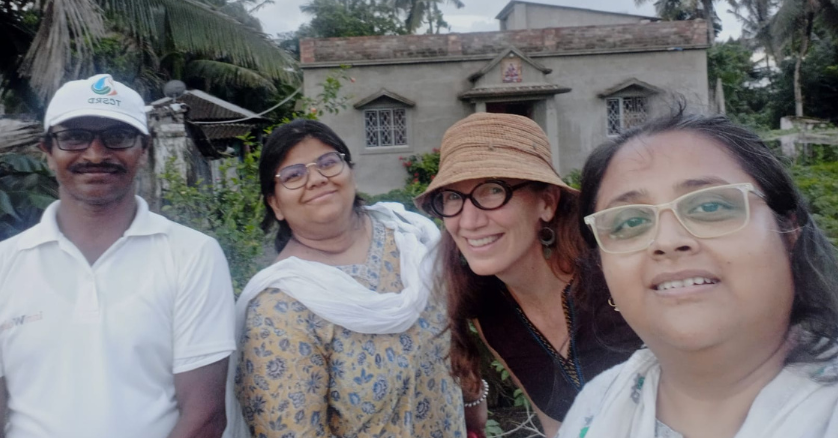
MSU scholars Krista Issacs, expert in smallholder agriculture and gender in agriculture, and Sejuti Das Gupta, expert in political economy, governance and culture, are researching changes in agricultural system and livelihoods in West Bengal, India due to climate change. The team’s goal is to understand how the geography of West Bengal, changes in weather intensity, and access to institutional support are shaping fish and paddy livelihood strategies of the local communities. With the support of MSU’s Center for Gender in Global Context through Strategic Partnership Grant (SPG) funding, Issacs and Das Gupta worked with Chandrani Dutta, their regional partner and field specialist, to conduct surveys and interviews in villages across West Bengal, documenting the diversification of livelihoods and women empowerment as male outmigration has increased. This trip not only provided an opportunity for data collection, but it also led to the development of new relationships with nongovernmental organizations (NGOs) in West Bengal and opened the door to new possibilities of giving back to the community.
Prior to this recent trip to West Bengal, Truman Forbes, an MSU James Madison College undergraduate student, went to West Bengal to conduct a two-week pilot survey in the spring of 2024. He received funding from the Kapur Endowed Scholarship and the Koo Global Student Scholarship. Forbes found this visit to be very interesting and encouraged the researchers to further their work in this region.
Issacs and Das Gupta collected some initial data in the summer of 2024, but there was not enough information to write a paper, so the researchers sought additional funding to continue their project and strengthen the partnership.
Through this trip, Issacs and Das Gupta further developed their relationship with regional partners. Visits coordinated by Dutta allowed the team to collect data and learn more about West Bengal communities. They were also able to recruit and connect with a student translator from a local university, and they visited a small regional college.
The researchers hoped to be able to give back to the community as well. “One of the things that kind of got us interested in finding other organizations there is to be able to not just come in and do research, but also to...be supportive in some way or another,” Issacs said. The names of the two organizations are Mahila Samiti, Tagore Society and Jaladarsha Collective. The focus of the initiative between community partners and MSU is women and livelihood.
Issacs and Das Gupta conducted many interviews with West Bengal communities. This research provides a foundation for the team to further develop research proposals. They hope to use this information to inform people of the climate crisis and how it is affecting West Bengal.
“There are these waves of adaptation and then a new set of challenges again,” Das Gupta said. There is not a simple solution to the issue in West Bengal, but the researchers hope to inform future policy initiatives and research endeavors that support the neglected region.
While the team wants to write a paper, they also hope to give back to the community more directly. They wrote proposals to see if local companies would give funds to support women's work. While they have not yet heard back about these proposals, they are optimistic about the opportunity.

EVENT
Muslim Journeys Campus Walking Tour
October 15, 2026

NEWS
Photo contest celebrates international engagement
EVENT
Returned Peace Corps Volunteers Tell Their Stories
October 19, 2026

NEWS
Celebrating 20 years of Muslim Studies at MSU